

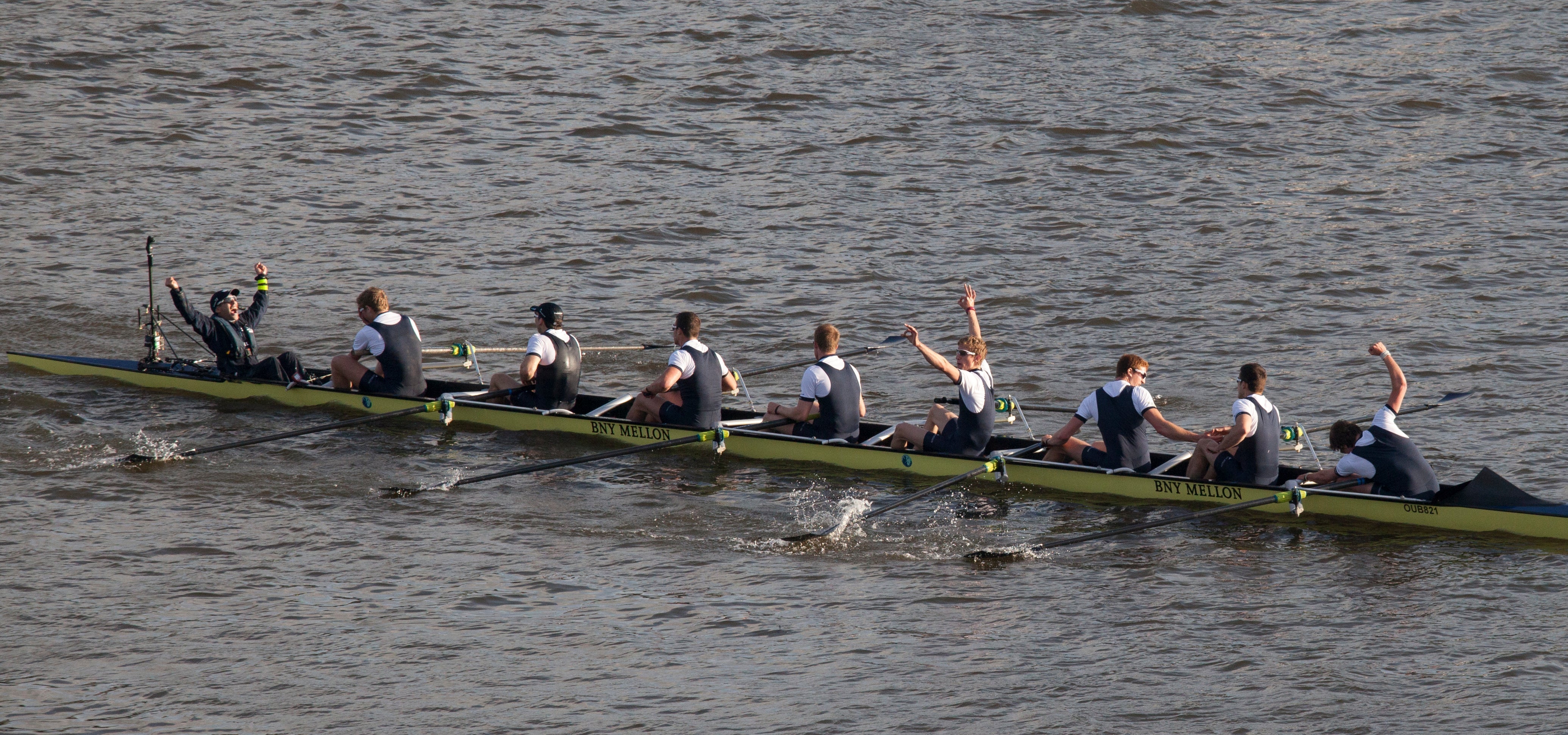
Amateur level sport is rarely regarded as a lucrative marketing opportunity for brands and sponsors. But when amateur sport is televised to an audience of over 2.82 million people, the stakes change.
On the 4th of April 2026, the banks of the River Thames will fill once again with spectators as two of the nation’s most prestigious Universities, the University of Oxford and the University of Cambridge, compete against one another in a 4.25-mile rowing race.
The first Men’s Boat Race between Cambridge and Oxford took place on the 10th of June 1829. It was initially a fairly irregular fixture, but over time the event has become a highly anticipated annual event in the University Calendar. Just under 100 years after the first Men’s Race, the Women’s Boat Race began in 1927. Like many women’s sporting events, coverage in the early years was limited and the original location and date of the competition was different to the men’s race. From 2015, the Women’s Boat Race was raced on the same day as the Men’s competition, the same course (The Championship Course), and both events received full television coverage.
Whilst rowing would typically be classed as a more niche sport, due to limited participation from the wider population, the Boat Race has piqued the interest of more than just the students at each University.
The race is watched by millions across the nation, and, as a result, holds the potential to generate revenue through sponsorship and on-site activations. This article will go on to explore the potential for revenue generation from the Boat Race for both sponsors of the teams, and for the local economy.
Revenue Generation for the Local London Economy
Each year, the boat race draws crowds of over 200,000 to the banks of the River Thames.
Whilst the athletes at each University are regarded as some of the best in their sport, and some may consider the level of training they undertake to be equivalent to that of professional athletes, attending the event is free, unlike the majority of professional sports.
Spectators are able to watch along the riverbank and towpaths in Putney, Fulham, Hammersmith, Barnes and Chiswick. For those looking for a more luxurious experience, there are also a range of hospitality experiences that can be purchased if you wish to enjoy the spectacle with Boat Race Alumni, and with drinks and food included.
Despite the event being free for most attendees, the impact on the local economy is still substantial. Recent events have delivered an economic impact of £13.3-15.0m for the local London economy.
Free entry does not mean attendees don’t spend money – spectators pay for local hotels, buy food and drink from local vendors and enjoy a “day-out” in the city.
In some ways, free access to the sporting event may even increase its revenue generation potential for local hotels, pubs, restaurants and bars. When a large number of attendees may be students with limited disposable income, the lack of ticket cost means more money can be spent on the day itself.
A study by WH Chambers in 2020 found that, when taking into consideration the different scale of the events, the Boat Race generated 40% more spend per athlete than the London Olympics. Whilst this is not to say that, if the boat race had as many competing athletes, it would generate more revenue than the Olympics, it does show something important – despite being an amateur event between University sports team, the Boat Race does carry genuine capacity to generate revenue.
Why Sponsor the Boat Race?
Despite not being a professional sporting event, the Boat Race does have a number of highbrow sponsors. These include Channel 4 (the event broadcasting partner), CHANEL (the Title Sponsor) Fortnum and Mason, Chapel Down, and the Graduate Hotel (by Hilton).
A common thread can be found with these event sponsors – luxury.
Despite the Boat Race being at the amateur level, the event offers sponsors significant value.
The reputations of the two competing Universities are highly prestigious. They carry with them long histories, traditions, and notable alumni. As a result of this, the two institutions draw visits from tourists from around the globe, boosting the two cities economies, and it is therefore no surprise that a sporting event between the two is a popular spectacle.
Alumni from the two Universities also often remain engaged with events such as the Boat Race. Given the two Universities are frequently recognised for increasing the earning potential of their graduates, the audience for the Boat Race is likely not only vast, but also wealthy.
Logo placement and brand activation at the boat race therefore gives these sponsors access to attention from a desirable global audience. And attention drives revenue.
Viewership Statistics
Whilst in-person attendees provide a key source of revenue for the local London economy, as well as sponsors of the event, the value does not end there.
In 2025, the Boat Race had the highest UK viewership of the weekend’s sporting events, which included The Masters golfing tournament, and F1s Bahrain GP.
Viewership of the Women’s Boat race increased by 14% compared to 2024, with the overall event viewership up 25.2% from the previous year.
The steadily increasing viewership numbers reflect the great potential amateur sport can have as an investment opportunity for brands and sponsors.
Not only can they benefit from in-person activations with the 200,000 event attendees, but they can also enjoy greater brand-recognition, as well as the association with the UK’s most elite Universities, on an even greater scale.
Is the Boat Race Worth the Investment?
Many brands may look first to mainstream sports or global events when it comes to investing in partnerships and activations.
The Boat Race, however, shows that when a more niche event has a strong global reach and an engaged audience, the potential value can be substantial – particularly for brands targeting affluent, engaged and globally distributed audiences.


Sheffield keeps World Snooker Championship until 2045 with UK£45m Crucible refurb
Strategic Sponsorship Choices: Formula E