

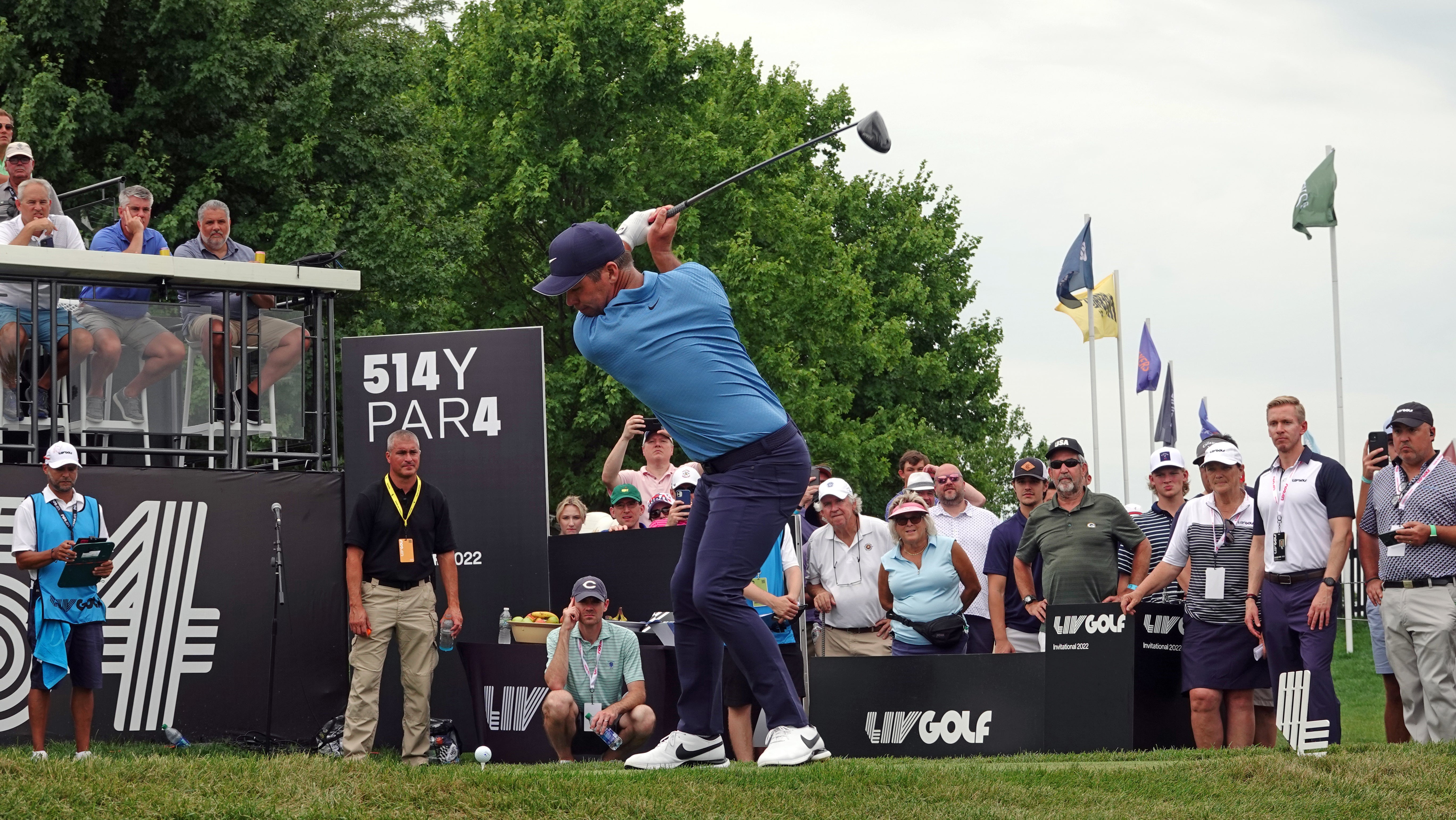
LIV Golf didn’t just disrupt men’s golf. It changed what sponsors and players think golf is worth.
For a long time, the business model around elite men’s golf felt relatively settled. The PGA Tour was the premium U.S. product. The DP World Tour was both a historic circuit and a talent pipeline. Sponsors more or less knew where the prestige sat, where the biggest audiences were, and what kind of returns they could expect.
LIV Golf changed that.
Not simply because it signed star players, or because it injected Saudi money into the sport, but because it forced everyone else to reprice the value of attention, loyalty and talent. In other words, LIV altered the commercial psychology of men’s golf. That has had real consequences for the sponsorship and revenue capacity of both the PGA Tour and the DP World Tour.
The easiest way to see it is this: before LIV, the established tours largely controlled the market. After LIV, they had to defend it.
The Impact on the PGA Tour
LIV arrived with guaranteed contracts, a global schedule and a willingness to challenge the PGA Tour’s traditional control over player participation and commercial structure. As explored in a Pace International Law Review article, the PGA Tour objected not because golf had never had multiple tours, but because LIV directly threatened the Tour’s business model, exclusivity rules and market power.
That matters for sponsorship because sponsors buy certainty almost as much as they buy visibility. Once LIV created a genuine competitive market for top players and premium events, certainty disappeared.
That loss of certainty had two immediate effects.
First, the PGA Tour had to spend more to keep its product elite. The PGA Tour began to tie players more directly to the business itself through its equity model: in 2024 it launched PGA Tour Enterprises with Strategic Sports Group backing,saying players would have access to more than $1.5 billion in immediate and future equity, and in January 2026 it expanded that player equity program, with more than $1 billion in granted equity value to date.
That is not a minor accounting tweak. It is a post-LIV answer to a post-LIV labour market.
Second, LIV proved that sponsors who once may have avoided the disruption could, in fact, be persuaded to buy into it. The series claims to have generated $500 million in total across league and team partnership revenue in 2025. The 2026 seasons brings backing from big brands like Rolex, HSBC, Salesforce and Qualcomm, as well as Under Armour, Callaway and Ping at the team level.
That is a remarkable marker because it suggests LIV is no longer just burning capital to purchase relevance; it is building a commercial proposition that brands are willing to fund.
Even if you believe LIV still lacks the heritage or week-to-week audience profile of the PGA Tour, it has succeeded in resetting the conversation. Sponsors no longer have to treat the traditional tours as the only serious option.
When reflecting on the impact of LIV, some would argue that the PGA Tour was in a strong enough place to handle this challenge. Shifts were made to compensate players in ways that they accepted, and many stayed loyal to the Tour. Recent player returns like Brooks Koepka and, soon, Patrick Reed, prove that LIV doesn’t quite have the pull that some thought it may have had.
But even if player loyalty to the tour has remained, there has undoubtedly been some resulting economic shifts to counteract LIV. And the impact of these is perhaps most greatly felt by the DP World Tour.
The Impact on the DP World Tour
When the latest deal between the PGA Tour and the DP World Tour was struck in 2022, amidst the chaos of LIV golf, there was an additional clause included – one which allows the alliance, scheduled to run until 2032, to end in 2027.
The Guardian reported that the PGA Tour’s annual investment payment into the DP World Tour reached £21.5 million in 2024.
Whilst this number, to onlookers, seems relatively small for an organisation like the PGA Tour, increased scrutiny of the budget in the wake of the formation of the tours equity model means every penny spent is turning heads. With the threat of LIV seemingly minimised, but the financial impact remaining, the question for the PGA Tour of whether the subsidy is worthwhile remains.
In addition to a potentially unstable and dependant position with the PGA Tour, the DP World Tour has lost a number of blue-chip sponsors, including to LIV, while also dealing with the long-term talent drain through the pathway that sends 10 players a year to the PGA Tour.
The combination of investment uncertainty, loss of sponsorship, and a consistent loss of talent, puts the tour in a difficult position.
The DP World Tour also knows that its players have alternatives and that its premium names carry a market value beyond Europe.
Jon Rahm’s recent comments make that tension visible. In rejecting a 2026 conditional-release arrangement, he argued that the DP World Tour was trying to “benefit both ways” from LIV players’ impact, while also imposing fines and minimum-event requirements. Whether one agrees with his framing or not, the quote reveals something important: LIV players now see themselves not as outcasts seeking re-entry, but as assets whose presence can lift tournament value. That is a very different sponsorship landscape from the one the European Tour used to inhabit.
The Impact
In practical terms, LIV has increased the price of relevance.
For the PGA Tour, that has meant paying more to retain stars, creating richer bonus structures, and sharing more of the commercial upside with players. The Tour can still command the strongest overall package in men’s golf, but it cannot do so on the old terms. It has had to become more expensive, more star-centric and more investor-conscious.
The Guardian’s reporting that PGA leadership now wants to “revise” its deal with the DP World Tour, in light of new leadership, new investors and a new player equity program, fits that logic perfectly. The Tour is looking harder at every outgoing pound and dollar because LIV forced golf into a more openly competitive business environment.
For the DP World Tour, the problem is harsher. LIV has made elite golfers more commercially valuable while making mid-tier tour economics less stable. That leaves the DP World Tour with fewer easy answers. If it leans on LIV-linked stars, it risks political and governance complications. If it distances itself from them, it may weaken fields and sponsor appeal. If it continues as a feeder to the PGA Tour, it loses talent. If the PGA Tour decides its subsidy is no longer worth it, the European circuit becomes more exposed still.
In that sense, LIV has changed sponsorship and revenue capacity in the most fundamental way possible: it has made golf’s established tours less able to set the terms by themselves.
And once a market loses the power to set its own terms, it usually never gets that power back in quite the same way.


DP World Tour Announces New Betting Partner
Pro Padel League raises US$15m to fund growth